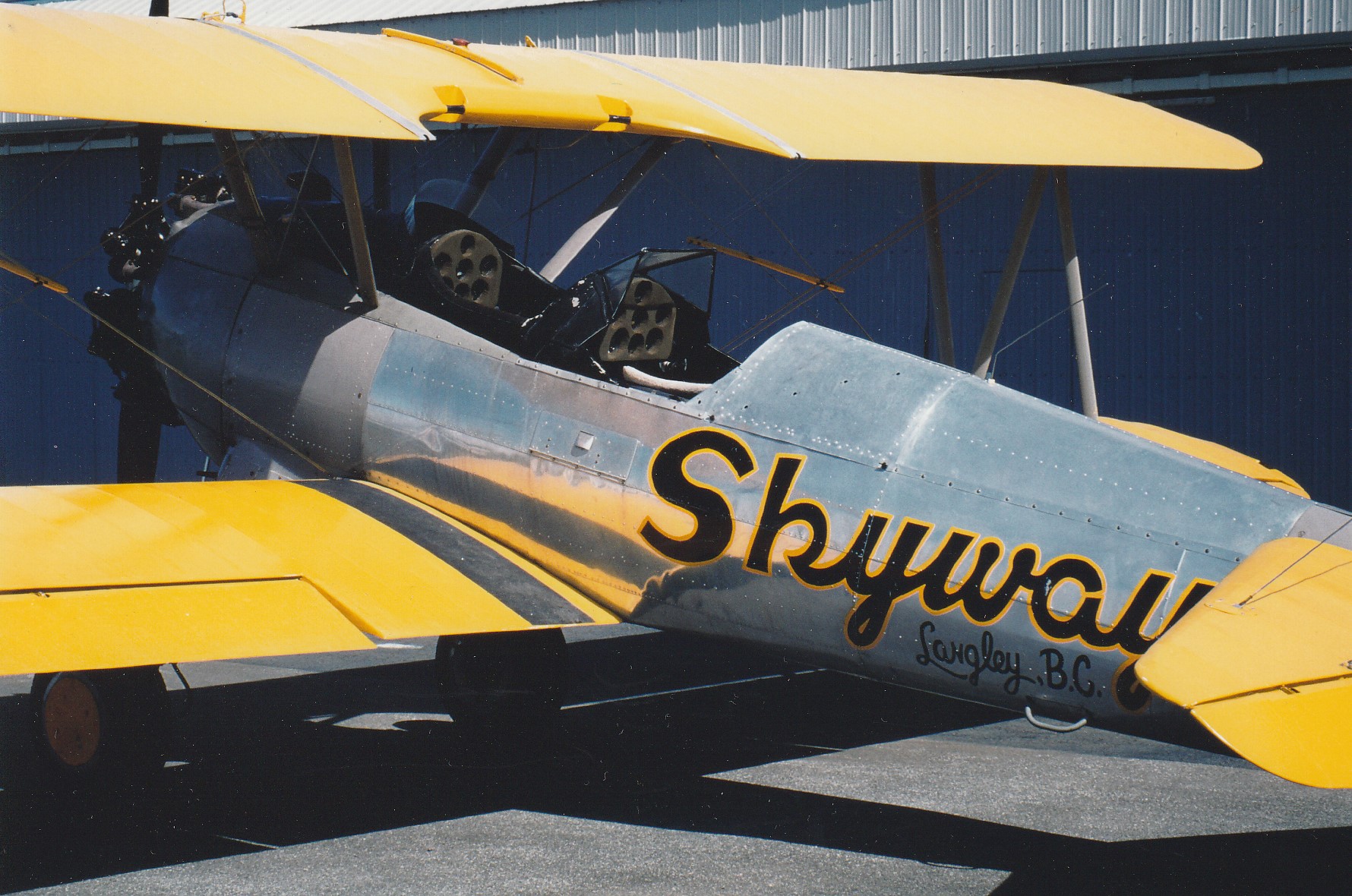
Boeing A75N1 Stearman
General Description
Lloyd Stearman formed the Stearman Aircraft Corporation in 1927 and established a factory in Wichita, Kansas. In 1934 the Stearman Aircraft Corporation became a subsidiary of Boeing. A number of models of Stearmans were built for the airmail service or oil company executive travel. In Canada, Trans-Canada Air Lines bought three Stearman Model 4 Senior Speedmail airplanes for pilot training and surveying new routes and were used from 1937 to 1939.
The best-known Stearman type was the Model 75. The prototype of this two-seat, open cockpit biplane first flew from Wichita in October 1934. It had fabric-covered wooden wings, single-leg landing gear and a welded-steel fuselage. It was fitted with a Lycoming R-680 radial engine, and the first trainers that were designated PT-13s, were delivered to the US Air Corps in mid 1936. In 1940, demand for the trainer outstripped the Lycoming engine company’s capacity to supply engines and this led to the Continental R-670-engined version, called the PT-17.
Widely known as the Stearman, Boeing Stearman, or Kaydet, it served as a primary trainer for the United States Army Air Forces and the United States Navy. Approximately 50% of all US military pilots, who fought in WWII received their initial flight training in these sturdy aircraft. A further 10,000 pilots from the RAF and Fleet Air Arm were trained using the Stearman at British Flying Training Schools that operated throughout the United States between 1941 and 1944.
Being such an effective training airplane, 300 US-built Stearmans (known as the PT-27) were purchased by the RCAF in the spring of 1942. They served with No. 3 Flying Instructors’ School, Arnprior, Ontario and No. 4 Elementary Flying Training Schools, spread out at different locations in the Prairies. Disappointingly, the Stearmans were delivered without the promised night-flying equipment and the open-cockpit configuration was completely unsuitable for Canadian winters. In November 1942, the decision was made by the RCAF to return the Stearmans to the USAAF in exchange for the same number of Fairchild Cornells with enclosed cockpits. In total, over 10,000 Stearman trainers were built, and it is celebrated as the second most widely produced biplane in the world, second only to the Antonov AN-2. The latest reports suggest that there are still over 2,000 Stearmans in existence world-wide, and over 1,000 of them are still actively flown.
In the immediate post-war years they became popular as crop dusters, sports planes, and were also used for aerobatic and wing walking displays at air shows. The crop duster conversions had the front seat removed and a large pesticide tank installed, known as a hopper. They also often had larger engines installed such as the Pratt and Whitney R-985 Wasp Junior. This engine produced 450hp which more than doubled the Stearman’s original power. Many Stearmans converted to crop dusters also had their original fabric covered fuselage replaced with a metalized covering. The reason they did this was because the pesticides used in the spraying were so corrosive that over time they would eat away at the fabric, whereas a metal covered fuselage would ensure a much longer lasting airplane.
Our Boeing A75N1 Stearman
Our Stearman was built in 1940 as a PT-18 by the Stearman Aircraft Company, a division of Boeing, in Wichita Kansas. The designation PT-18 meant that it was powered by a Jacobs 755 with 225hp. Our Stearman was built for use by the United States Army Air Corps and given the military serial 40-1966. Its service started October of 1940 at Sikeston Missouri, and by 1942 it was transferred to Hemet, Ontario, and then Oxnard, all in California. In 1943 it was re-engined to have a Continental R-670 220hp engine and was based in Perrin Field Texas, Chickasha Oklahoma, and then finally San Angelo Texas. In late-June 1945, with the war winding down, our Stearman was transferred to the Reconstruction Finance Corporation for liquidation, and it was sold from the Defense Plant Corporation field at Baton Rouge Luisiana.
After being retired from military use, it was purchased by Henry P. “Hank” Troh of Portland Oregon and registered with the FAA as N53791. Hank Troh was a pioneer and a driving force in the Porland Oregon aviation community for over 35 years. He was responsible for constructing three different airports in the Portland area, giving joy flights to thousands of passengers, providing flying lessons to hundred of student pilots, and brokered airplane sales for scores of people. He passed away in 1968 and was posthumously inducted into the Oregon Aviation Hall of Fame in 2012. While flown civilly in the United States, the Stearman was upgraded with a fully metalized fuselage and a larger Pratt & Whitney R-985 450hp engine.
In May of 1960, the Stearman was purchased and imported into Canada by Skyway Air Services Ltd. of Langley, BC, and registered as CF-FWV. Skyway Air Services was the brainchild of WWII veteran and local aviation pioneer, Art Seller. Skyway Air Services was a flying school, agricultural spray provider, and aerial firefighting company. His company used this Stearman as a crop sprayer training airplane which meant that it to retain its front seat; instead of having its front seat removed for the installation of a pesticide hopper tank. After retirement from use at Skyway Air Services it had it’s powerplant switched back to a Continental R-670 and the Stearman remained in the Seller family until November 2016 when it was generously donated to the Canadian Museum of Flight.
This Stearman is one of the most historically significant aircraft to come into the Museum’s collection. It was regularly flown by Skyway founder, Art Seller, and it symbolizes the innovations made in the local aviation community with by Skyway Air Services.
For more on the history of Art Seller and Skyway Air Service, see the Aviation History section; Art Seller and Skyway Air Services Ltd.
The Canadian Museum of Flight is dedicated to preserving Canada’s aviation heritage, from rare artifacts to the very aircraft that shaped our history. Your support allows us to restore, maintain, and share these treasures with the public, inspiring future generations to reach for the skies. Every gift makes a lasting impact — join us in keeping aviation history alive: Donate Now!

Technical Details: A75N1 (PT-17 3,519 delivered)
- Serial: 75 523, C-FFWV
- Manufactured: 1940
- Engine: 220 hp (164 kW) Continental R-670-5 seven-cylinder, air-cooled radial
- Maximum speed: 135 mph (217 km/h)
- Cruise speed: 96 mph (155 km/h)
- Empty weight: 1,931 lb (878 kg)
- Loaded weight: 2,950 lb (1,338 kg)
- Span: 32 ft 2 in (9.81 m)
- Length: 24 ft 9 in (7.54 m)
- Height: 9 ft 8 in (3 m)
- Wing area: 298 sq ft (27.7 sq. m)