
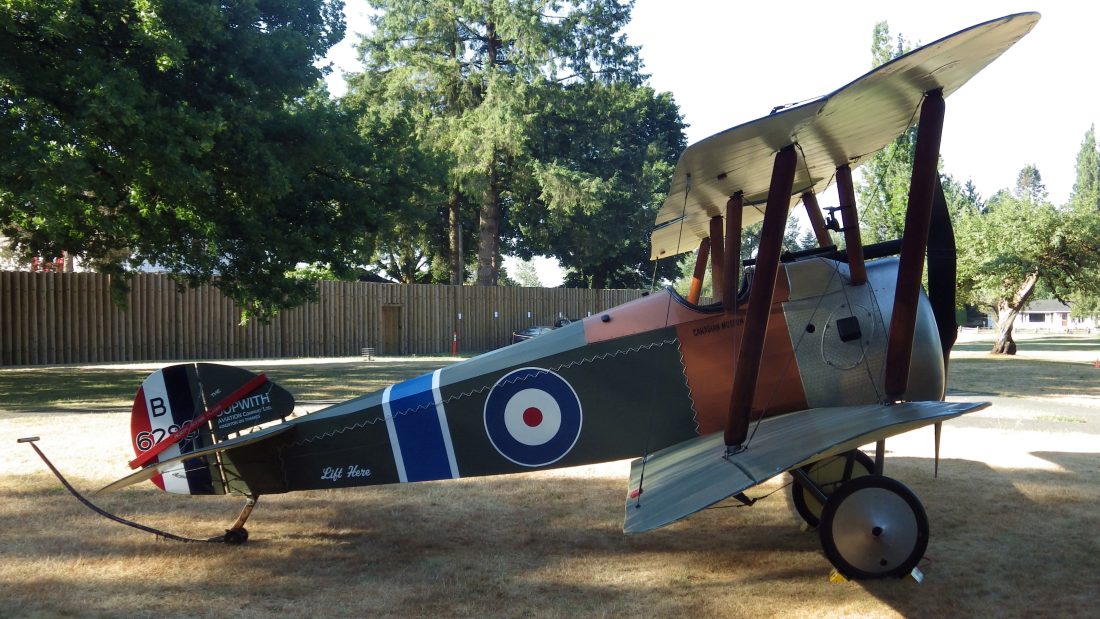
Sopwith Camel (Replica)
General Description
(Only available for viewing at special events)
The Sopwith Camel was a single-seat biplane scout aircraft designed and built by the Sopwith Aviation Company of Kingston-upon-Thames, England. The company’s factory was originally an old skating rink but was repurposed for the building of airplanes by the Sopwith Company
The Camel used the most modern construction techniques with a wooden frame and interior structure, and fabric covering. This, combined with it’s 9-cylinder Clerget rotary engine, made the Camel a fast and maneuverable airplane that was very well suited for aerial combat. The Camel was a state-of-the-art fighter aircraft in 1917, much like the Lockheed Martin F-22 Raptor is today.
The first flight of the Sopwith Camel was in December of 1916 and it entered military service in June 1917. The Camel was a development of the venerable Sopwith Pup and had many technical refinements over the Pup, including simplified construction, a more powerful engine, and an increase in armament from a single Vickers .303 machine gun to being equipped with two. The Camel got its name from the pronounced bulge or “hump” that was created by the metal fairing covering the two machine guns. This hump made the airplane loosely resemble a camel, hence the nickname. Camel was not the airplane’s original name, but the pilots that flew it always referred to it as the Camel, and the name stuck.
A highly maneuverable biplane, the Sopwith Camel accounted for more aerial victories than any other Allied aircraft during World War I, having been credited with destroying 1,294 enemy aircraft. Despite its success in combat, the Sopwith Camel had the reputation of being notoriously difficult to fly. Its rotary engine created an enormous amount of torque which allowed the airplane to roll faster to the right than any other fighter of its day, but that same torque had the opposite effect going the other way, and rolling to the left was slower in comparison. Many people embellished the difference in roll rate, but the difference between sides was only 10 degrees per second. On top of that, the airplane was directionally unstable which is a good thing for a fighter plane, and it had very sensitive and responsive controls. All of these factors made the Camel extremely challenging for novice pilots. In fact nearly as many Camel pilots were killed in training accidents as they were in actual combat. But, in the hands of an experienced pilot, the Camel was a lethal weapon.
Notable Canadian Sopwith Camel pilots include Captain Donald Roderick MacLaren, Lieutenant-Colonel William George “Billy” Barker, Major Raymond Collishaw, Captain Frank Granger Quigley, Major Clifford Mackay McEwen, and Captain Arthur Treloar Whealy amongst many others. Most of these pilots recored aerial victories in multiple different types of aircraft they flew during World War One, but Captain Donald Roderick MacLaren has the distinction of recording all his 54 aerial victories at the controls of a Sopwith Camel, more than any other Canadian pilot. Captain MacLaren had 8 more aerial victories in a Camel than the nearest allied pilot, Colonel William “Billy” Barker, another Canadian pilot, and 15 more victories than the nearest non-Canadian allied pilot, Captain William Lancelot Jordan of South Africa.
In total, almost 5,500 Camels were built between 1917 and 1918 by 8 different U.K. based companies. Their entry into service with the Royal Flying Corps and Royal Naval Air Service, along with the Royal Aircraft Factory S.E.5a cemented allied air superiority for the remained of the war.
There are only eight authentic Sopwith Camels that have survived to this day. These airframes are located at the Canadian Aviation and Space Museum in Ottawa, the Imperial War Museum in London, the National Air and Space Museum in Washington DC, the Royal Museum of the Armed Forces and Military History in Brussels, Belgium, the Vintage Aviator Ltd in New Zealand, the Polish Aviation Museum in Krakow, Poland, the National Naval Aviation Museum in Pensacola, Florida, the Royal Air Force Museum in London.
Our Sopwith Camel (Replica)
The Museum’s Sopwith Camel is a full-scale static display replica constructed by CMF volunteers in 1985. The project began in volunteer Murray Lundberg’s automotive workshop in Fort Langley, using original aircraft plans, and was completed in the Museum’s workshop at the CMF’s original Crescent Road site in South Surrey.
Construction of the replica was carried out with the assistance of aircraft mechanic apprentices employed through a Canada Works Employment Development grant administered by the Federal Minister of Employment and Immigration. Wherever practical, original construction methods and materials were replicated. Exceptions include the use of non-aircraft-grade wood, a Dacron fabric covering, and a fibreglass engine cowling. The engine itself is a cleverly crafted wooden mock-up designed to resemble an original rotary engine.
Sopwith Camel replica was also designed and built to be easily assembled and disassembled. It has quick release wing attach points with simple pins and turnbuckles. Along with a custom-built trailer, the Camel can be transported to any location and put together in approximately 15 minutes by a team of 4 people.
This Camel replica can be frequently seen at museum displays during airshows and other special events throughout the Fraser Valley. It provides spectators with some interesting technical points such as the unique rotary engine where the cylinders rotate with the propeller and replica machine guns that can be used to explain the development of propeller synchronization which was developed during World War One and allowed machine guns to fire through the propeller arc without shooting off the propeller.
The Canadian Museum of Flight is dedicated to preserving Canada’s aviation heritage, from rare artifacts to the very aircraft that shaped our history. Your support allows us to restore, maintain, and share these treasures with the public, inspiring future generations to reach for the skies. Every gift makes a lasting impact — join us in keeping aviation history alive: Donate Now!

Technical details (F.1 Camel):
- Engine: 130 hp Clerget 9-cylinder rotary engine
- Max. Speed: 117 mph (188 km/h)
- Ceiling: 19,000 ft (5790 m)
- Climb Rate: 10 minutes to reach 10,000 ft (3048 m)
- Weight: 929 lb (421 kg) empty, 1453 lb (659 kg) fully loaded
- Span: 28 ft (8.5 m)
- Length: 18 ft 9 in (5.7 m)
- Height: 8 ft 6 in (2.6 m)
- Wing area: 231 sq ft (21.5 sq m)
- Guns: Two .303 inch Vickers machine guns synchronized to fire through the propeller.
- Bombs: Four 20-lb Cooper bombs


