
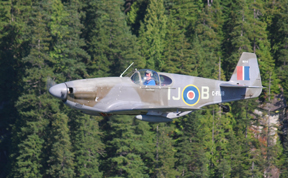
Jurca P-51B Mustang (Replica)
General Description
(Not available for viewing)
For many, the North American P-51 Mustang, along with the Supermarine Spitfire and many others, captured the imagination of WWII enthusiasts around the world. However, the purchase and operating costs of a genuine example put them out of reach of most people. Over the decades since WWII numerous builders have attempted to recreate these historic aircraft, usually designing them as scaled down versions of the original which would allow for lower powered and more economical engines to be used than the original Rolls Royce Merlin.
Marcel Jurca was the designer of this homebuilt replica P-51 Mustang. Marcel was born in Romania in 1923, and between 1940 and 1944 he was enlisted in the German air force, or the Luftwaffe. In this role Marcel flew the Herschel HS-129 ground attach aircraft. After WWII, Marcel defected to France, became a citizen and settled in an area just outside Paris. In 1956 he started building his own designs, including single-seat and two-seat aerobatic aircraft, most notably, the Jurca Sirocco, Autan, and Tempete. Having gained experience with these types, Jurca then began designing replica WWII fighters. The P-51 Mustang was the first replica design Jurca created, and he nicknamed the Gnatsum, which is Mustang backwards. This design came in 2/3, 3/4, and full-size versions and plans were made available for any homebuilder to purchase. All variants were to be constructed from wood and fabric, unlike the original which was all-metal. The scaled down variants were also designed to accept much smaller engines than the original, and the 2/3 version was designed to easily accept a 200-horsepower engine, which is 1/6th the horsepower of the Mustang’s original Rolls Royce Merlin engine, making it much easier on the builder’s pocketbook. With the popularity and success of his replica Mustang design, Jurca went on to design several other replica fighter planes including the FW-190, ME-109, Spitfire, and the P-40 Kittyhawk.
Eventually, Marcel Jurca sold the manufacturing rights for his designs to Falconar Avia, based in Edmonton, Alberta, and then they were resold in 2019, to Manna Aviation in New South Wales, Australia.
Our Jurca P-51B Mustang
The Museum’s Jurca P-51B Mustang is of the MJ-7 variant, which means it is of the 2/3 scale variant. It’s wingspan is 24 feet 9 inches, whereas the original Mustang boasted a wingspan of exactly 37 feet. It is of all-wood construction and uses many components from the aircraft industry. It has a retractable undercarriage and conventional flight control surfaces and flaps. The fuselage, wings and empennage are of Sitka spruce framework with a plywood covering and an exterior finish of thin fiberglass. It is powered by a six-cylinder 260-horsepower Lycoming aircraft engine.
Our example was originally designed to carry two persons, but the museum’s example had the second seat removed and an additional fuel tank installed in its place.
The design represents the earlier P-51B model of the Mustang, which had high rear fuselage compared to the more common P-51D that had a lower rear fuselage and a bubble canopy. The canopy configuration on the P-51B is known as the “Malcolm Hood” which was originally made for the Supermarine Spitfire, and then later adapted for the North American P-51 Mustang.
This specific aircraft was built by Mr. I. J. Baptiste and first flew in New Brunswick in 1981. When painting his airplane, Mr. Baptiste cleverly disguised his initials in the military lettering on the side of the airplane. This means the markings on the airplane are not paying tribute to a specific Mustang from history, but it does present a paint scheme that is otherwise quite accurate for a WWII RAF P-51B Mustang.
After enjoying the airplane for several years, it was sold to Abbotsford resident, Mr. Joe Daems, who flew it locally for about 25 years before he donated it to the Canadian Museum of Flight, in 2008. After its acquisition, the Mustang replica was flown for a few years by the CMF and attended several airshows. It is currently out of service to have some modifications done to it to improve its serviceability. Once brought back to airworthy condition it will return to the local airshow circuit with the rest of the CMF fleet.
The Canadian Museum of Flight is dedicated to preserving Canada’s aviation heritage, from rare artifacts to the very aircraft that shaped our history. Your support allows us to restore, maintain, and share these treasures with the public, inspiring future generations to reach for the skies. Every gift makes a lasting impact — join us in keeping aviation history alive: Donate Now!

Technical Details:
- Manufactured: 1981
- Engine: Lycoming O-540, 260 hp six-cylinder horizontally opposed
- Maximum speed: 200 mph (322 km/h)
- Loaded weight: 1900 lb (862 kg)
- Span: 24 ft 9 in (7.5 m)
- Length: 23 ft 3 in (7.1 m)
- Height: 6 ft 3 in (1.9 m)
- Wing area: 114 sq ft (10.6 sq m)
(Photo credits: C. Hutchins)


