
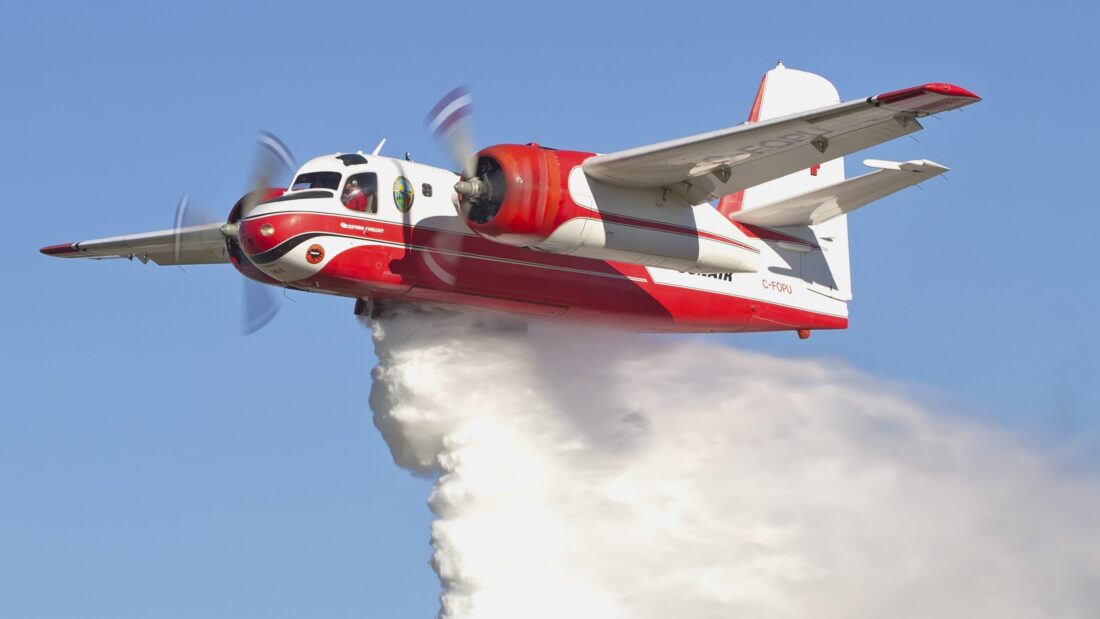
Conair Firecat
General Description
In 1954 the Royal Canadian Navy (RCN) selected the Grumman S2F Tracker for the anti-submarine search and attack role, to replace its aging Grumman TBM-3E Avengers. de Havilland Canada was given the contract to build 99 Grumman Trackers under license at their manufacturing plant in Downsview, Ontario. Prior to de Havilland Canada building any Trackers, the RCN ordered one Tracker aircraft for testing from Grumman Aircraft, which would then bring the total number being received by the RCN to 100. This first Tracker is now displayed at the Shearwater Aviation Museum in Nova Scotia. Besides the airframes being built in Canada by de Havilland Canada, the airplane’s engines, the Wright R-1820-82 engines, were also built under licence in Canada by Pratt & Whitney Canada Ltd. in Longueuil, Quebec. The Canadian prototype was first flown at Downsview by George Neal and Anthony Verrico on 31 May 1956, and deliveries to the RCN began the following October.
The Grumman Tracker was a twin-engine, high-wing monoplane with folding wings for carrier operation. To achieve low approach and manoeuvring speeds for aircraft carrier use, the Tracker was designed with a generous flap area comprising over 80% of the wing trailing edge. This left room for only small ailerons that were augmented by 13 feet of perforated spoiler that arced upward from two slots in the upper side of the down-going wing during a turn. The wings also featured a fixed leading-edge slot near each wingtip, the whole combination gave the Tracker exceptional turning and low speed capabilities and a stall speed of only 70 knots with flaps extended. All Canadian-built Trackers were built to the earlier “A” model airframe design with a fuselage length of 42 feet, and not to the 43 ft 6 in length of later Tracker models. The decision to stay with the shorter length fuselage was actually a necessity, because the Canadian Navy’s aircraft carrier, the HMCS Bonaventure, had a below deck hangar that would not fit the longer version of the Tracker.

Designed to be an anti-submarine patrol aircraft, the Tracker carried a retractable magnetic anomaly detector (MAD) boom extended rearwards from the tail, and a retractable radome for an APS-38 search radar that was fitted in the rear fuselage. The Tracker was also equipped with a 70 million candlepower searchlight carried under the starboard (right) wing, 16 sonobuoys housed in the rear of the engine nacelles, Julie echo-sounding equipment with 30 charges, and Jezebel long-range acoustic search equipment. For armament, the Tracker carried six Mk 43 torpedoes, two in the bomb bay and four under the wing. The Canadian-built Trackers also had some equipment installed to suit RCN requirements and these were originally designated the CS2F-1s but, after trials with the first 43 aircraft, equipment changes resulted in the designation CS2F-2. Structurally, the Canadian aircraft were identical to the US-built machines and were interchangeable in this respect.
The 100 Trackers built for the Royal Canadian Navy served with VS880 and VS881 Squadrons on Canada’s aircraft carrier, HMCS Bonaventure, and served at onshore bases with VU32 and 33 Squadrons. In 1970, the HMCS Bonaventure was decommissioned, and all Trackers were transferred to shore bases. This greatly limited the Tracker’s usefulness for conducting Anti-Submarine Warfare (ASW) patrols and in 1974 the RCN began retiring the Trackers and placing them into storage, until only 20 remained in service. By 1900, all of the remaining 20 RCN Trackers were retired.

After retirement from military service Trackers found a second life as water-bombers fighting forest fires in Canada, the United States, and other countries around the world. One such company that converted Grumman Trackers for water-bomber use is Conair Aviation of Abbotsford, BC.
In the 1970’s, Conair Aviation acquired a large number of Trackers from a variety of sources including the Canadian Armed Forces, the province of Ontario and the State of California in order to develop an aerial firefighting aircraft that eventually came to be known as the Firecat, which had its first test flight in 1978. They modified the Trackers by raising the cabin floor by 20 cm (8 in), removing all superfluous military equipment, and fitting it with a 3,296 litre (870 U.S. gal) retardant tank. This made the Firecat almost 1,500 kg (3,300 lb) lighter than the original military version, the Tracker. Beginning in 1988, many Firecats were upgraded and re-engined with Pratt & Whitney Canada PT6A-67AF turbine engines and renamed Turbo Firecats. These feature extra underwing fuel tanks, an increase in Maximum Take Off Weight (MTOW) of 680 kg (1,500 lb) to 12,480 kg (27,500 lb), while the lighter turbine engines also reduce the airplane’s empty weight. The Sécurité Civile Organisation in France took delivery of 14 Firecats over a period of five years commencing in May 1982, followed by a similar number of Turbo Firecats. A total of 36 Trackers were converted by Conair to Firecat and Turbo Firecat configuration.
Our Conair Firecat (Grumman Tracker)
The Museum’s Firecat was originally a Grumman CS2F Tracker, built under license by de Havilland Canada in Downsview, Ontario. The Royal Canadian Navy operated 100 Trackers and the museum’s example was 38th built by de Havilland, with serial number DHC38, and designated RCN 1539.

Our Tracker was taken on strength by the Royal Canadian Navy in April 1958 and sent to VX-10 Experimental Squadron where it was equipped for military use, and test flown. After that it served aboard Canada’s aircraft carrier, the HMCS Bonaventure with units VS-881 and VS880. From 1959 to 1968 our Tracker served with VU-32 Utility Squadron in Shearwater, Nova Scotia and from August 1968 to December 1969 it served with VU-33 Utility Squadron in Patricia Bay, British Columbia. After this, it was retired from military use and sent to 1105 Transport Support Detachment (TSD) in Saskatoon, Saskatchewan for long-term storage.

On the 28th of September 1972 our Tracker was struck of strength and sold to the Ontario Ministry of Natural Resources and given the civilian registration CF-OPU. In this time, it was converted to a water-bomber and coded “54”. It was used by the Ontario government to fight forest fires throughout the province and then in 1980 it was sold to Conair of Abbotsford, BC and re-registered as C-FOPU. Conair converted the Tracker to a Firecat in April 1981 and designated it serial 007 and coded “564”. From 1981 until 2013 this Firecat was operated under contract by the provincial government of British Columbia and the Yukon Territory to fight wildfires throughout Western Canada. Our Firecat’s final year of fighting fires was 2012 when it was stationed in Whitehorse, YK. The following year it was donated by Conair to the Canadian Museum of Flight and flown into Langley Airport by Conair’s Director of Operations, Ray Horton, and Canadian Museum of Flight volunteer, Bill Findlay.
Our Conair Firecat is not located on the Canadian Museum of Flight premises, but it is viewable at Langley Airport by the general public from adjacent the intersection of 216th Street and 52nd Avenue.
The Canadian Museum of Flight is dedicated to preserving Canada’s aviation heritage, from rare artifacts to the very aircraft that shaped our history. Your support allows us to restore, maintain, and share these treasures with the public, inspiring future generations to reach for the skies. Every gift makes a lasting impact — join us in keeping aviation history alive: Donate Now!
Technical Details (Grumman Tracker)
- Serial: DHC38, RCN 1539, CF-OPU, C-FOPU
- Engines: Two 1,525 hp Wright R-1820-82 radials
- Maximum speed: 287 kt (531.8 km/h)
- Cruising speed: 130 kt (240.9 km/h)
- Empty weight: 17,500lb (7,945 kg)
- Loaded weight: 24,193lb (10,984 kg)
- Span: 69 ft 8in (21.23 m)
- Length: 42 ft 3 in (12.88 m)
- Height: 16ft 3 ½ in (4.96 m)
- Wing area: 485sqft (45.1 sq m)
- Initial rate of climb: 1,920 ft/min (585 m/min)
(Sources: Canadian Aircraft Since 1909, Molson/Taylor; Air Enthusiast Jan/Feb 1996; Wikipedia. Thanks to Robert Stitt of Air Enthusiast for an update on technical details.)


