Bristol Bolingbroke Mk IVT
General Description
The Bolingbroke was a development of the Bristol Type 142. The Type 142 was conceived by Bristol designer Frank Barnwell in response to a challenge put forward in 1933 by newspaper magnate and owner of the Daily Mail and Daily Mirror, Lord Rothermere, to build a fast civilian passenger airplane. The resulting aircraft, the Bristol Type 142, first flew in April 1935 and with a top speed of 307 mph (494 km/h) it was the fastest twin-engine aircraft in the world and faster than any operational military aircraft in service at the time. Because of its excellent performance, the British Air Ministry quickly ordered the type 142 for use by the RAF and designated this model the Bristol Blenheim.
In early 1937, the Royal Canadian Air Force (RCAF) sought a general reconnaissance aircraft and, in line with Canadian government policy, turned to Britain for its supply. At the time, the Bristol 142M Blenheim was undergoing testing primarily for use as a bomber. However, Bristol was also developing the Bolingbroke, an improved version of the Blenheim intended as an interim replacement for the aging Avro Anson reconnaissance aircraft. The Blenheim was ultimately ruled out due to poor cockpit visibility, narrowing the RCAF’s choice to the Bolingbroke.
Although the British Air Ministry had decided to discontinue the Bolingbroke’s development, the RCAF requested that the project continue, and the Bolingbroke made its first flight on 24 September 1937. The early Bolingbrokes featured an all-metal, stressed-skin construction, carried a crew of four, and was armed with one fixed forward-firing .303 Browning machine gun and one flexible aft-mounted .303 Browning machine gun. It could also carry up to 1,000 pounds (454 kg) of bombs.
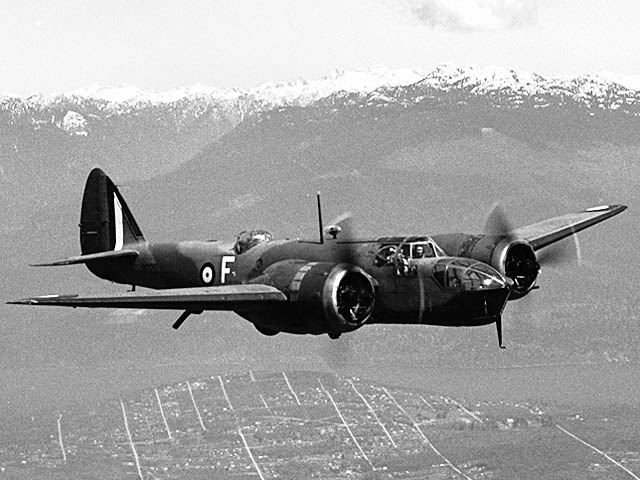
In November 1937, a contract was awarded to Fairchild Aircraft of Longueuil, Quebec, for the construction of 18 Bolingbroke aircraft. These initial models, designated the Bolingbroke I, were equipped entirely with British equipment. The first of them flew in September 1939. Fairchild was also tasked with developing a seaplane variant for coastal reconnaissance. To improve performance on floats, the RCAF specified the installation of 920 hp Mercury XV engines in place of the earlier 800 hp Mercury VIII, resulting in the Bolingbroke III, but only one was built. The main production version was the Bolingbroke Mk IV, which retained the basic British airframe but was fitted with the more powerful Mercury XV engines and American instruments and equipment. To enhance cold-weather capabilities, rubber de-icing boots were installed on the wings and tail surfaces. The most numerous variant was the Bolingbroke Mk IVT, developed for bombing and gunnery training. It was equipped with a Boulton Paul Type C turret mounting two Browning machine guns, and some were also converted for use as target tugs. A total of 626 Bolingbrokes were delivered between December 1939 and September 1943.
During the early parts of WWII the Royal Canadian Air Force had squadrons that operated Bolingbrokes for coastal defence in British Columbia, with No. 115 (Bomber Reconnaissance) Squadron at Patricia Bay, BC, No. 8 (Bomber Reconnaissance) Squadron at Patricia Bay, BC, and No. 147 (Bomber Reconnaissance) Squadron at Sea Island, BC. When No. 115 Squadron was activated as part of the Aleutian Islands Campaign, one of its Bolingbrokes was credited with attacking a Japanese Submarine. The RCAF also had squadrons on the East Coast of Canada; those being No. 8 (Bomber Reconnaissance) Squadron based in Sydney, Nova Scotia, before being moved to the west coast, and No. 119 (Bomber Reconnaissance) Squadron at Yarmouth and then Sydney, Nova Scotia.
Once the Bolingbroke became obsolete and retired from the front line duties it was relegated to its primary role as a training platform with the British Commonwealth Air Training Plan (BCATP). The BCATP used the Bolingbroke for bomber and gunnery instruction and instead of being painted in camouflage colours as it would have carried with an operational squadron, they were painted in BCATP yellow with black numbering, and standard RCAF roundels. Other Bolingbrokes were used as target tows and were painted in high visibility yellow and black stripes.
With over 500 Bolingbrokes serving in the BCATP in Canada, by the end of World War Two there were hundreds of airframes available for sale by the War Assets Corporation. Many were purchased by farmers who found them to be very useful sources of parts and hardware that they could use around their farms. In fact, the survival of so many Blenheims and Bolingbrokes is largely due to the significant number of airframes that were unknowingly preserved on farms, later to be rescued by WWII relic collectors and museum.
Today there are just over 20 surviving examples of Blenheims and Bolingbrokes worldwide. A handful are airworthy or nearing airworthy status, while most are preserved in static display or dismantled and stored.
Our Bristol/Fairchild Bolingbroke Mk IVT

Our Bolingbroke was built in 1942 by Fairchild Aircraft of Longueil, Quebec and designated RCAF 9896. It was delivered to RCAF No. 4 Training Command on 13 July 1942 and stationed at No. 8 Bombing & Gunnery School in Lethbridge, Alberta. It was painted in full BCATP yellow with black numbering and standard RCAF roundels. It served as a bomber and gunnery trainer, helping prepare bomber crews for action in the European theatre of WWII. It was used for this purpose until its pending disposal in 1944. At this time, it was transferred to No. 2 Air Command and then stored with Maintenance Command at the No. 1 Reserve Equipment Maintenance Unit. RCAF 9896 was eventually struck of strength by the RCAF in 1946 and sold by War Assets to an unknown farmer in Legend, AB, located approximately 100km east of Lethbridge, AB.
After years of having its useful parts removed and bullet holes being shot into it, RCAF 9896 was eventually provided to the Canadian Museum of Flight on permanent loan by Rudy Yancy, Sr. of Skiff, AB, and the airframe was transported to the museum’s homesite on Crescent Road in 1981.
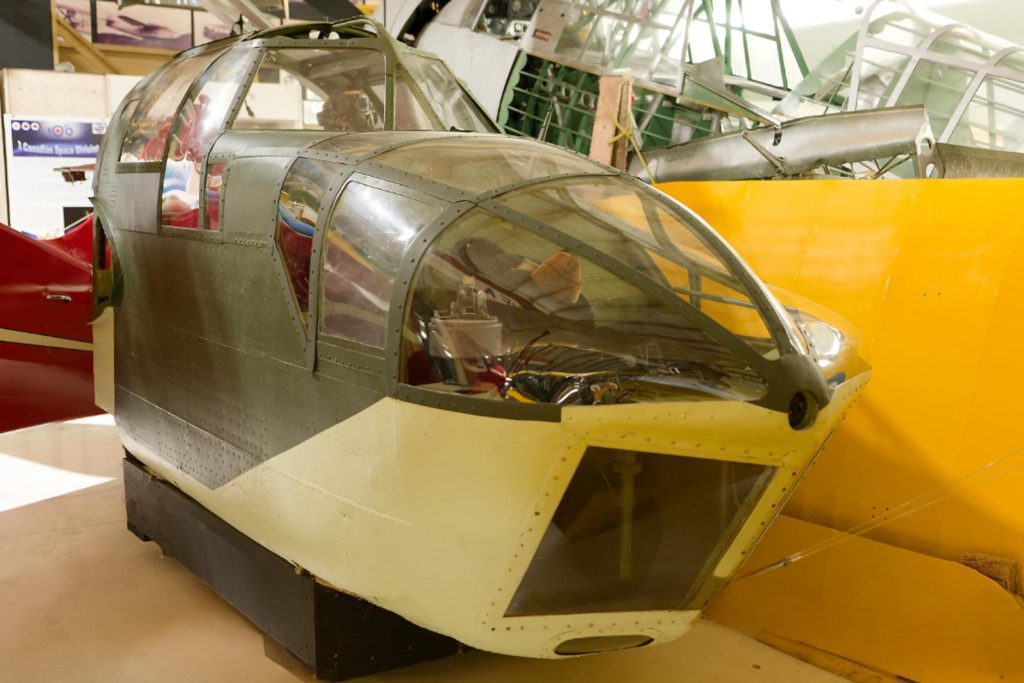
What remains of RCAF 9896 are all of its major components: the fuselage, wings, tail feathers, center-section, and nose section. Most of the major components of RCAF 9896 are in storage awaiting eventual restoration to static condition, while the nose section has been meticulously restored and can be seen on display in our museum’s hangar.
The Canadian Museum of Flight is dedicated to preserving Canada’s aviation heritage, from rare artifacts to the very aircraft that shaped our history. Your support allows us to restore, maintain, and share these treasures with the public, inspiring future generations to reach for the skies. Every gift makes a lasting impact — join us in keeping aviation history alive: Donate Now!
Technical Details (Mk IV/IVT):
- Engine: Two 920 hp Bristol Mercury XV radial (click for details)
- Maximum speed: 262 mph (421 km/hr at 14,000 ft (4,267 m)
- Cruising speed: 214 mph (344 km/hr at 14,000 ft (4,267 m)
- Empty weight: 8,963 lb (4,069 kg)
- Loaded weight: 14,500 lb (6,583 kg)
- Span: 56 ft 4 in (17.17 m)
- Length: 42 ft 9 in (13.03 m)
- Height: 9 ft 10 in (3.0 m)
- Wing area: 469 sq ft (43.57 sq m)
- Armament: One 0.303 Vickers K in nose, and two 0.303 Brownings in dorsal turret. 1000lbs bomb load.