Bensen B-8M Gyrocopter
General Description
The gyrocopter was invented in the early 1920s by Spanish engineer Juan de la Cierva. His first successful example was the Cierva C.4 that first flew in 1923.
A gyrocopter, or autogyro is characterized by a free-spinning rotor that turns because of the passage of air through the rotor from below. A separate propeller provides forward thrust, with the engine and propeller at the rear of the fuselage. Whereas a helicopter works by forcing the rotor blades through the air, drawing air from above, the autogyro rotor blade generates lift by changing the angle of the air as the air moves upwards and backwards relative to the rotor blade. The free-spinning blades turn by autorotation; the rotor blades are angled so that they not only give lift, but the angle of the blades causes the lift to accelerate the blades’ rotation rate, until the rotor turns at a stable speed with the drag and thrust forces in balance. Pitch control is achieved by tilting the rotor fore and aft, roll is control by tilting the rotor laterally (side to side), and a rudder provides yaw control.
Igor B. Bensen (1917–2000) was the founder of the Bensen Aircraft, which produced a successful line of gyrogliders (rotor kites) and autogyros. He was born in Russia and won a scholarship to study in the USA. He gained a Bachelor of Science degree in mechanical engineering from Stevens Institute of Technology in 1940.
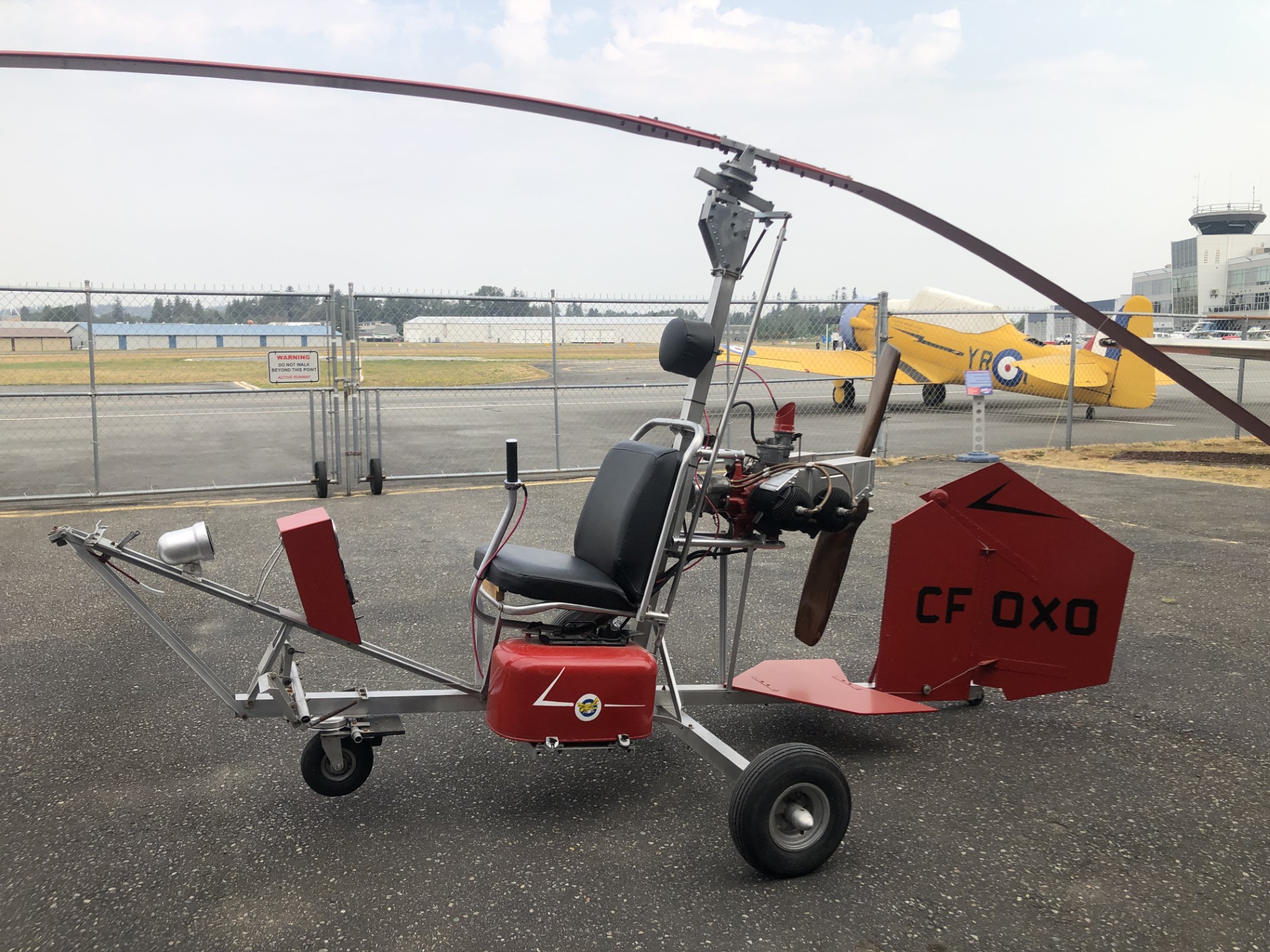
The Bensen B-8 is a small, single-seat autogyro developed in the United States in the 1950s. Its design was a refinement of the Bensen B-7, and like that aircraft, the B-8 was initially built as an unpowered rotor-kite. It first flew in this form in 1955, and on 6 December a powered version, designated B-8M (M for motorised) first flew. The design proved to be extremely popular and long-lasting, with thousands of sets of plans sold over the next thirty years. The B-8’s design is extremely minimalist, with not much more to the aircraft than a pilot’s seat, a single tailfin, a rotor, and (in powered versions) the powerplant.
The Bensen Aircraft Corporation sold over 10,000 sets of plans and kits starting in the mid-1950s, and it is estimated that at last 4,000 to 5,000 examples were built.
One B-8M, named Spirit of Kitty Hawk was used to make a special commemorative flight exactly duplicating the first flight of the Wright brothers’ original Flyer on the sixtieth anniversary of the historic flight. This same aircraft was flown by Igor Bensen himself between May 1967 and June 1968 to set twelve world and US speed, distance, and altitude records for autogyros, the largest number of such records to be held by any non-military rotorcraft.
Our Bensen B-8M Gyrocopter
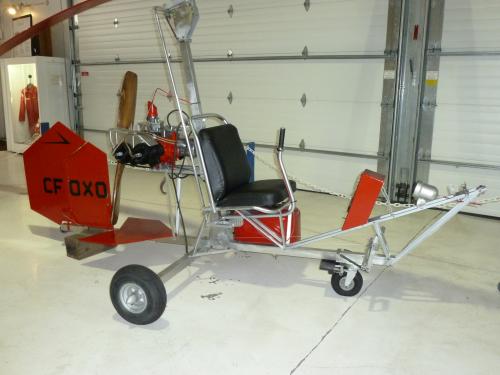
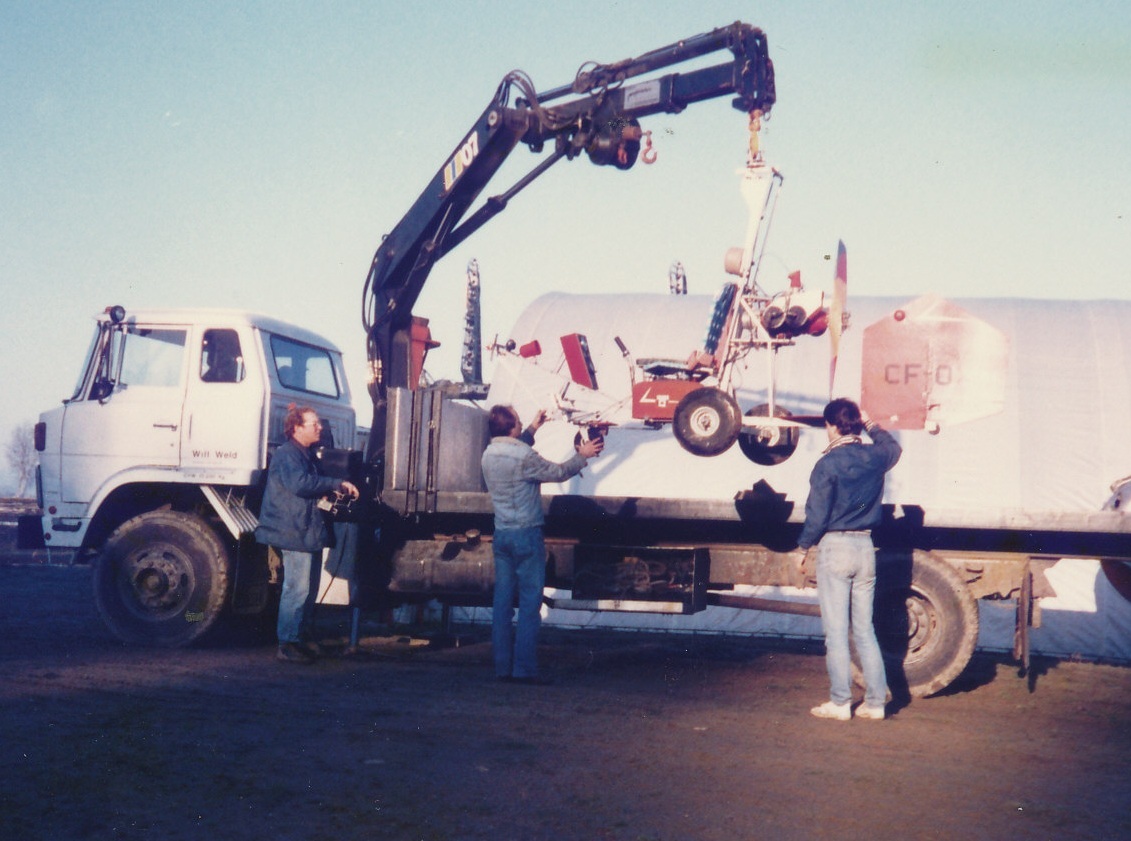
The Museum’s Bensen B-8M was built locally from plans in 1963 by Mr. R.D. Forsayeth and later sold to Neville Maynard in 1966. It was registered as CF-OXO and operated in the greater Vancouver area up until 1974. In November 1983 the airframe was sold by Neville Maynard to Lloyd Bungey who in turn donated the gyrocopter to the Canadian Museum of Flight the following month.
The builder of CF-OXO, R.D. Forsayeth, used a McCulloch 2-stroke engine for its power. The McCulloch engine was designed for use in target drones during WWII, and after the war they were available in large quantities. These engines were extremely inexpensive to purchase from War Assets, but because they were designed for short-term use in drones, they were not designed to last and became very unreliable after prolonged use. Despite this, many people powered their homebuilt airplanes and gyrocopters with McCulloch’s and accepted the short lifespan in favour of the low purchase price.
The Canadian Museum of Flight is dedicated to preserving Canada’s aviation heritage, from rare artifacts to the very aircraft that shaped our history. Your support allows us to restore, maintain, and share these treasures with the public, inspiring future generations to reach for the skies. Every gift makes a lasting impact — join us in keeping aviation history alive: Donate Now!

Technical Details:
- Serial: DF1, CF-OXO
- Manufactured: 1963
- Engine: 72 hp (54 kW) McCulloch 4318 flat-four, two-stroke piston engine
- Maximum speed: 55 mph (137 km/h)
- Empty weight: 247 lb (112 kg)
- Loaded weight: 500 lb (227 kg)
- Main rotor diameter: 20 ft 0 in (6.91 m)
- Length: 11 ft 3 in (3.43 m)
- Height: 6 ft 3 in (1.90 m)
- Main rotor area: 314 ft2 (29.17 m2)
Performance:
- Range: 100 miles (160 km)
- Endurance: 1.5 hours
- Service ceiling: 12,500 ft (3,800 m)
- Rate of climb: 1,000 ft/min (5.1 m/s)